
You switch the thermostat to heat on a cool morning and notice a message you have not thought about since last winter:
AUX HEAT.
It is easy to wonder whether something has failed or whether your next electric bill is about to climb.
The message alone does not answer either question. Auxiliary heat can be a normal part of a heat-pump system, but the timing and amount of use matter.
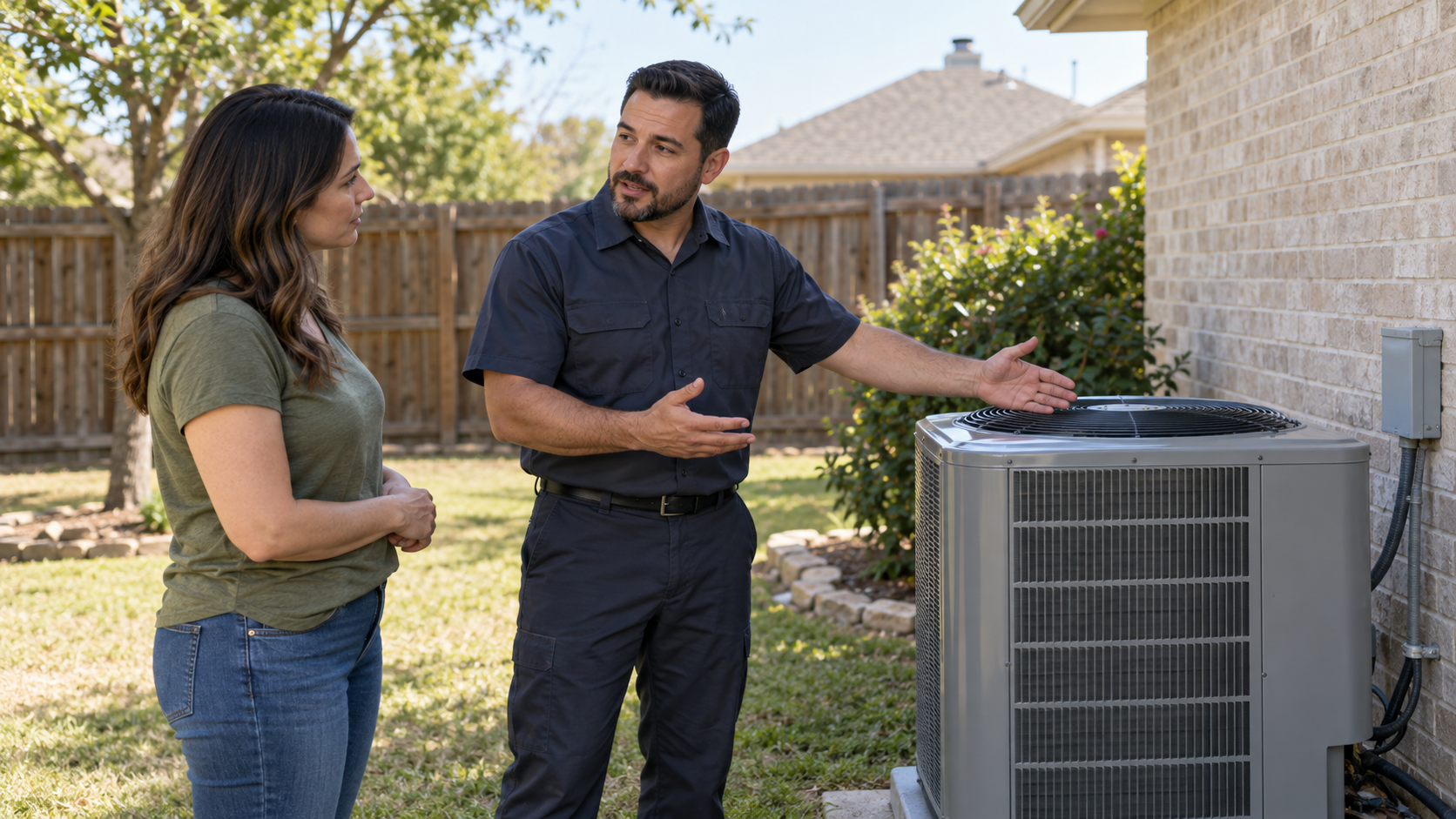
For Georgetown and Central Texas homeowners, understanding the difference can help you know when to leave normal operation alone and when to request a professional review. If you are still comparing equipment types, start with our guide to heat pumps in Central Texas.
What Does AUX HEAT Mean?
Auxiliary heat is a backup or supplemental heat source used with some heat-pump systems.
In many all-electric homes, that backup comes from electric resistance heat strips. Other configurations use a furnace as part of a dual-fuel system.
The thermostat and system controls determine when backup heat operates. In an all-electric system, heat strips can assist the heat pump. In a dual-fuel arrangement, the furnace typically takes over instead of running at the same time as the heat pump.
Your equipment and control setup determine the sequence. AUX is not a universal fault code.
When Can Auxiliary Heat Be Normal?
Backup heat may be used when the heat pump needs help meeting the home's heating demand.
Possible situations include:
- Colder outdoor conditions.
- Recovery toward a higher thermostat setting.
- A heat pump's defrost cycle.
- A configured changeover in a dual-fuel system.
There is no single outdoor temperature or exact runtime that applies to every house and model. System capacity, the home's heat loss, thermostat programming, and equipment design all affect the answer.
Do not assume AUX is unnecessary just because the weather feels mild to you. Likewise, do not assume continuous backup operation is normal without considering the rest of the system's behavior.
Why Backup Heat Can Affect Your Bill
Electric resistance heat generally uses more electricity per unit of delivered heat than a heat pump operating efficiently in heat-pump mode.
That does not make backup heat a bad feature. It has a purpose. The question is whether the system is using it appropriately.
With dual fuel, the cost comparison depends on fuel prices, equipment performance, and how the controls switch between heat sources.
No article can estimate your savings from turning a setting on or off without knowing the system and energy rates. Disabling backup heat can also prevent the home from maintaining an appropriate temperature.
The goal is correct operation, not eliminating the AUX indicator at any cost.
AUX Heat and Emergency Heat Are Different
Auxiliary heat is normally selected automatically by the controls when the system calls for it.
Emergency heat is generally a selectable mode that bypasses the heat-pump compressor and relies on the backup heat source.
Emergency heat is not simply a faster or more powerful everyday setting. Use it according to the equipment instructions and professional guidance, particularly when a heat-pump fault requires service.
If you find the thermostat in emergency mode and do not know why, ask before treating it as a normal winter setting.
When Should You Call for Service?
Request a professional review if you notice patterns such as:
- AUX staying on for long periods without an understandable reason.
- The home not reaching or maintaining the requested temperature.
- An unexpected change in electricity use alongside unusual heating behavior.
- Persistent heavy ice on the outdoor unit or repeated fault messages.
- Operation that changed after thermostat replacement or programming changes.
These observations do not identify a single failed part. They give the technician useful information.
Take a photograph of the display and note the outdoor conditions, indoor temperature, thermostat setting, and approximate duration. Also mention recent maintenance, repairs, or control changes.
What Can You Check Safely?
Start with ordinary homeowner checks:
- Confirm the thermostat is in the intended mode and follows the schedule you expect.
- Inspect the accessible air filter and replace it as instructed for your equipment and filter type.
- Keep supply and return grilles unobstructed.
- Observe the outdoor unit from a safe position and report unusual icing or operation.
Do not open electrical panels, change installer settings, chip ice from the unit, or handle refrigerant.
Large temperature changes can trigger backup heat on some systems. Ask whether a steadier setting or a heat-pump-compatible recovery schedule makes sense for your installation. A smart thermostat is only helpful when it is compatible and configured correctly.
Before the Next Cold Front, Understand Your System
Fall is a useful time to review controls and heating operation before colder weather makes the issue urgent.
Cook Heating and Air LLC provides heat pump services and thermostat installation and repair. Those services fit the practical questions behind an AUX message: what equipment you have, how it is configured, and whether it is operating as intended.
Common Questions About AUX Heat
Does AUX heat mean my heat pump is broken?
Not necessarily. It can be normal. Persistent or changed behavior deserves review in the context of your equipment and conditions.
Should I turn on emergency heat whenever it gets cold?
Do not use it as a routine shortcut. Follow the manufacturer's instructions and seek guidance if the heat pump is not working properly.
Can a thermostat problem cause unnecessary backup operation?
Incompatible equipment, wiring, or configuration can affect staging. A technician should evaluate the installation rather than relying on a display message alone.
Get Comfortable With What Your Thermostat Is Telling You
You do not need to become an HVAC technician to ask the right questions.
If your AUX heat use seems unusual, or your home is not warming properly, contact Cook Heating and Air LLC for a system-specific evaluation.
Request heating or thermostat service or call (512) 818-3899. Michael Cook and his team serve Georgetown and surrounding Central Texas communities.
General homeowner education. Controls, operating temperatures, backup heat arrangements, and costs vary by system and home. Follow the manufacturer's instructions. No diagnosis, energy savings, or repair outcome is guaranteed by this article.